
His servant picked up the spade and dug a grave long enough for Pahom to lie in, and buried him in it. Six feet from his head to his heels was all he needed. “How much land does a man need?” Tolstoy
Why does anyone making millions of dollars a year need a tax break? I sincerely do not understand this.
Congress is currently debating whether to extend Trump's tax cuts that are set to expire this year. While all taxpayers might be impacted, the richer you are, the more money you will save.
I don’t really care except that this tax cut seems to be coming at the expense of low income people: Medicaid, SNAPS, special needs students, and foreign aid recipients.
Way back when I was a high school English teacher, I had my juniors read the short story “How much land does a man need? by Leo Tolstoy. The gist of the story is that by trying to amass a huge amount of land, a peasant dies by over exerting himself. The lesson being that in the end, all the land anyone needs is enough for a grave. The classroom discussions that followed were always interesting, often revealing quite diverse values among the students. Money, service, family, leisure - what is the best thing for us to strive for in our lives.
It’s a question that in retirement I don’t need to ask myself much anymore. I long ago decided that enough income on which to live comfortably, not extravagantly, was enough. I’ve never yearned for a mansion, a yacht, a giant pickup truck, or a diamond studded Rolex. I am not envious of those with more money than I have. I value economic security, good health, positive relationships with friends and family, interesting books, and adventurous travel.
This is not to say that I don’t in some ways empathize with those who would like the finer things in life and have the money to afford them. People do seem to enjoy their possessions. I like my “things” as well - it’s just that their value lies in the memories they stir, not how much they might bring at auction.
But to paraphrase Tolstoy, just how much money does a person need?
Here is what really puzzles me. A person with one billion dollars invested in an account that pays just 3% has an annual income of thirty million dollars. Geeze, just enough to scrape by. What this tells me, for these billionaires who are determined to lower their taxes, it isn’t about the money. Or privately redistributing the funds to good causes.
It’s about keeping score. It’s about power. It’s about compensating for insecurity. It’s about winning a game. It’s a mental illness.
And we seem to have these nut jobs now running the country.
PS. On a related subject, I am glad when businesses make good profits since the investments in my IRA tend to do well. So I am not totally lacking in empathy for those who want less regulation, lower business taxes, etc. But I don’t think the health of my mutual funds should come at the price of the health of low income people.
PSS. Should I ever win the lottery (slight chance since I never buy tickets), I would take the winnings and create a kind of universal basic income for as many of my relatives and friends as possible. A trust fund that paid out, say, $50,000 a year would, I calculate, keep a person off the streets, but not living so well they are disincentivized to work. And yes, I’d keep a little for myself as well.
]]>

Each day when I was growing up, my grandmother put a coin in a small plastic piggy bank that sat on her kitchen counter. It looked somewhat like the one pictured above.
The coins were my college fund. For as long as I can remember, she insisted that I would one day attend college. And this was how she viscerally let know. When the bank was full, I would count out the change and, along with my small black account book, would head to the bank where the coins would be deposited and my balance increase. It was fun seeing the running tally rise over the years.
By the time I graduated from high school, I had about $600 in the account - no small amount in 1970 when tuition at a state college was about $140 a trimester. I honored my grandmother’s expectations by getting not just a bachelors degree but a couple years later my masters. I was the first in my family to get a college education.
Now Granny did have one rule about adding to the fund each day. The coin deposited had to be silver - it could not be a penny. Even an entire bank full of pennies would not have amounted to much. Even in the 1950s and 60s, pennies were held in low esteem. A penny would buy you a gumball and that was about it.
While I am deeply troubled by nearly every action our current president has taken in his first few weeks in office, one initiative I can get behind is his move to stop the production of pennies which take over 3 ½ cents to make. I could get behind the elimination of nickels as well which cost nearly 14 cents to make.
Even more than the economic foolishness of continuing to make these small coins, they are simply a nuisance. I don’t remember the last time I put a penny or nickel in my pocket instead of the change or tip jar on a counter.
If Trump’s and Musk’s goal is to improve the efficiency and lower the cost of the federal government, I can get behind it. But if your windows leak, you don’t tear down your house; you fix the windows. If bureaucrats lose their jobs, fine. But if humans lose the needed services their departments provide, that’s quite another story.
Getting rid of pennies is one thing; getting rid of entire programs that serve those in need is something quite different. I will keep looking for bright spots in the news over the next four years but I am not optimistic.

Tourists blocking the scenery at Torres del Paines National Park
Wine is not the answer but it will help you forget the question. - guide at the Vina Santa Rita winery
Home yesterday from a two week Road Scholar trip: Finis Terrae: Exploring the Wilds of Southern Patagonia. (Detailed itinerary in the link.) These short remarks about the trip are written as much or more to help me remember the adventure as they are to inform or, hopefully, amuse you. A link to 200+ photos from the trip is at the end of this post.

Wine tasting in Buenos Aires
This was a guided adventure rated as “Let’s Go” - the most active rating of all Road Scholar trips. And we did our share of walking and hiking, but little outside the comfort zone of the group which was composed of older adults (65-83, I think). We flew to Buenos Aires on an overnight flight and were picked up at the airport by the local guide. Everything on the trip was arranged - accommodations, meals, tours, hikes, and transportation. While there were some things I would probably have skipped or added were I to have planned an independent trip, it was lovely having someone else worry about the details. And our group of 16 people was quite compatible. No trouble makers. Unless I was so identified by the others.

In the La Roca neighborhood of Buenos Aires
Our two night stay in Buenos Aires included a tango show (Heidi and I were not allowed to dance) and a wine tasting along with tours of neighborhoods, a huge cemetery, and a look at the Pink House governmental center where Eva Peron gave her famous talk.

In the Ushuaia prison
A 3 tour flight took us to Ushuaia, Argentina's southernmost city. Before boarding our ship the next day, we hiked a regional park (at the end of the Trans American highway) and toured a prison converted to a museum. Oh, and we bought some Dramamine in case the seas were going to be rough.

Our cruise ship M/V Ventus Australis
A real highlight of the trip for me was the five day cruise from Ushuaia to Puerto Arena though around Cape Horn and through the Strait of Magellan. The boat was smallish with about 150 passengers, 4 decks, and multiple lounges. Some of the best meals I’ve ever eaten and - get this - an open bar. (Alcohol seemed to flow freely with every meal this trip - especially wine and pisco sours.) Our cabin felt spacious and had a great window for watching the glaciers glide past. The crew was great.

Zodiac boarding
Each day, one or two trips aboard the rubber zodiac rafts were offered. My favorite were to areas near glaciers (Pia, Condor, etc) where we could hear the loud cracking of calving ice and see the splashes on the water. Here, as in the rest of the world, glaciers are receding at a rapid pace.

Re-creation of an indigenous people’s shelter near Cape Horn,Tierra del Fuego
The trip was loaded with lectures on history, geology, and the economies and politics of Chile and Argentina. The pre-Coumbian peoples had a tough environment in which to live, and sadly, few survived.

Pia Glacier in the Beagle Channel
We were told to be prepared for rough seas, but I only felt the boat rock once during the cruise, late at night. I suspect I would have slept through it had the door on the in-room safe not been banging back and forth. None of our excursions were canceled due to poor weather conditions. In fact, the weather was good for us the whole two weeks! Didn’t need the Dramamine.

Magellanic penguins
On the final day of the cruise, we had the chance to take a short walk around the small Magdalena Island, a popular nesting place for hundreds of penguins. Reminiscent of the Galapagos, the birds had no fear of the idiotic tourists who visited. I only hope we were as entertaining to them as they were to us.

In Torres del Paines
After disembarking, a long afternoon bus drive took us to Torres del Paines (pie’-nays) National Park, just north of Puerto Natales, where we stayed in rather rustic cabins just outside the park entrance. With the exception of some very high winds, the weather was great and the cloud cover did not cover the marvelous peaks in the region, including the three “torres” (towers) from which the park gets its name. Some beautiful hikes over the two days we were there.

Hiking in Torres del Paines
If I had any criticism of the tour, I would say that I’d have preferred a bit longer hikes with fewer stops for a guides’ often lengthy lectures. But then I have to remind myself that this was a Road Scholar trip. Oh, the roads in the park could have used some work as well - I thought the bus was going to shake apart a few times.
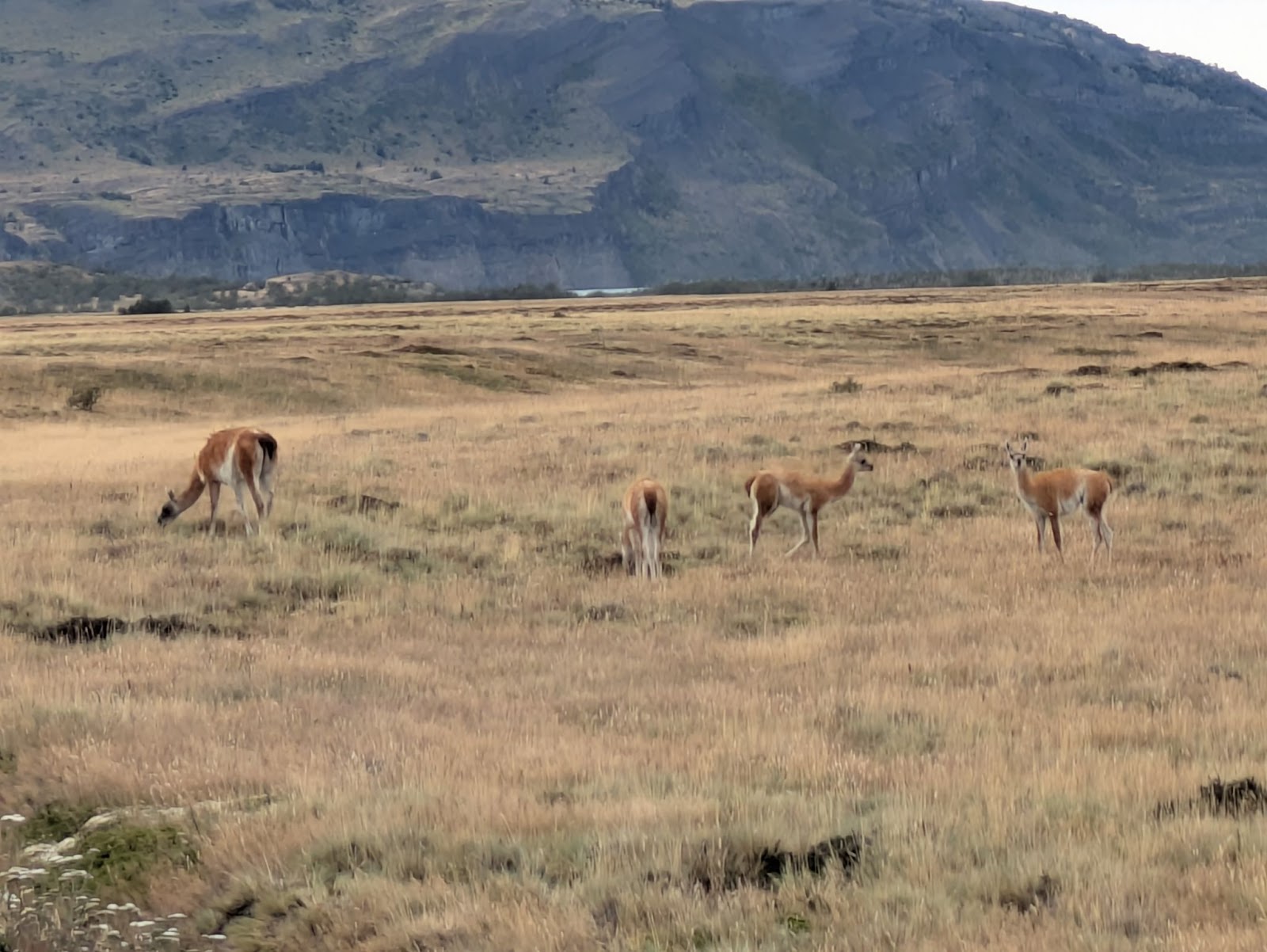
Wild guanacos
Guanacos (wan-ah'-kos), a species of llama, were plentiful in the park. But then as I alway say, if you've seen guan-aco, you’ve seen them all. (Nobody else on the tour thought that was funny either.)

Attacked by a milodon - thankfully they only eat vegetarians
On our way to the small airport in Puerto Natales, we stopped at a huge cave where the remains of the megafauna milodon were discovered in the 19th century. Humans had also lived in the cave in ancient times.

Small sample of the wines aging in the Vina Santa Rita winery
Our last two nights were spent in the Chilean capitol city of Santiago. I had visited the city once before in 2006 to attend a conference, but remembered very little about it. We visited a great archaeological museum, hiked a city park, and had a good time at a winery just south of the city. More wine tasting! Our hotel was very luxurious.

A group photo. Christian, our guide, is at the far left.
This was probably one of the least stressful, most pleasant trips I have taken. It was active, it was interesting, and it was relaxing. I only hope I can still be traveling like this at age 83, like Mary who is in the middle of the photo above.
Next adventure - a bike/boat trip on the Danube this summer!
]]>
The organizations for which I volunteer would have a difficult, if not impossible task, of being effective were it not for me.
Well, that’s a bit extreme. Let’s just say all of us who volunteer provide important services. And I believe that most volunteers, like me, try to be professional - reliable, competent, and caring.
But for those paid employees who must manage us, volunteers might be a mixed blessing. As a manager of paid employees, I always had some degree of leverage over their performance - evaluations, scoldings, or even the threat of termination. (Johnson’s Experience in Assigning Tasks: You may as well give unpleasant jobs to people who are already unhappy.) But how does one criticize the work of someone who is simply there for the sake of doing good?
I asked that question of the housing manager of the senior apartment building for which I regularly drive a large van, taking residents shopping and on “field trips.” She kindly replied that “her” volunteers did not cause any problems so the issue of correcting them or discharging them has never come up. Hmmmmmm.
And she was addressing me. A driver who once put a hole in the side of the van by driving too close to a construction trailer. That has bumped over trash containers and that regularly hits curbs. I have asked on rare occasion to change the date or time of my service or for someone else to take my date. I would say 99% of the time I do a good job. But I am far from the perfect volunteer.
This holds true for each of the volunteer activities I perform including driving people to doctor appointments, serving as a volunteer Ombudsman in an assisted care facility, leading hikes for an outdoor club, and participating in Rotary activities. While I do my darndest to bring the professionalism I displayed in my paid work to these jobs, I do mess up now and then. And just maybe I am not as good at doing these things as I think I am.
Bless those who manage volunteers by helping them improve their performance without making them so angry or hurt or feeling incompetent that they simply quit. I don’t know the secret. But I wonder if more supervisors and managers treated paid employees like volunteers, it might just help both the effectiveness and the lives of all concerned.
]]>

Now that winter temps have actually arrived here in Minnesota (-19 this morning), I’ve started wearing the warm cap you see in the photo above. A photo that was taken over 15 years ago.
I genuinely enjoy wearing my old clothes. The long sleeved t-shirt I wore on Kilimanjaro in 2010. Warm socks that have held together for years. A leather jacket that has been to the shop for repairs. And soft flannel shirts that still bring warmth and comfort despite being purchased in some previous decade of brands no longer made. The Carhartt coat I am wearing in the photo above still hangs in my garage as my work coat.
Old clothes make me happy not just because they are physically comfortable, but because they often stir good memories.

The vest and shirt I am wearing in the photo above, taken on the Inca Trail’s Dead Woman’s Pass in 2006, still hang in my closet. (I just wore the shirt last week.) I think of the challenge of that hike each time I button it up.
Sadly, due to physical aging, I have no pants from days gone by due to an increased waist size. How did I go from 34 waist, 36 inseam to 38 waist, 34 inseam? My favorite shoes that I wear daily, Merrell Jungle Mocs, have been the same style and color for heaven knows how many years, but they get replaced due to wear and tear now and then.
As a wannabe minimalist living with limited closet space, I make a real effort to only keep what I need. I have made it a habit that when I buy a new shirt, I donate an old shirt to a charity. When nearly every shirt one owns is loved, it makes buying new ones quite difficult.
One clothing category I am struggling with weeding out is my old dress clothes - the sports jackets, dress trousers, and neckties I wore over the 43 years of my professional career. The odds of my needing dress clothes for work in the future are miniscule and I only get invited to swanky dinners and dances once every other decade. I do still have a 20+ year old black suit that I wear to funerals and weddings. Maybe it is enough and I can free up a few more coat hangers by ditching some jackets.
I wonder if we all might be better at living within our means if we knew that when we purchased any new thing, an old one had to go. May all my donations find loving owners.
]]>
The “evils” of social media have been getting a good deal of press lately. Zuckerberg’s decision to no longer do fact checking on Meta has been controversial. Excessive time spent on social media by kids (and adults) has been blamed for less healthy mental conditions. The platform X is used by people sowing discord and disinformation to the detriment of our country’s political stability.
Recently Tim Stahmer posted on his Assorted Stuff blog this cartoon and comment:

For me, the value of social media hit a peak several years ago and since has been on a steep decline. It would certainly have greater worth if more people would adopt Pig’s stupidity filter… https://www.assortedstuff.com/stupidity-filter/
With Zuckerberg’s decision to stop fact-checking, I have a friend who simply has decided to stop using Facebook. I deleted my Twitter account when Musk bought the company. I have no interest in joining Blue Sky.
Yet aren’t social media networks simply tools, and like other tools, be used for both good and ill? One of my axioms is that the same hammer can be used to both build a cathedral and break its windows. So while the negative uses of social media platforms seem rampant, are there ways we can teach kids how to use these tools in ways that may be of value to them? I would suggest:
-
Limits. I restrict who and what I follow on Facebook, using it to mainly keep up with friends and family and a few (travel) companies. I have long ago blocked the comments of those people who are overly political. I hit the “Hide all from…” link on posts daily. My feed is still a little cluttered, but it does not seem to contain the nut job opinions and factoids from either the left or right. Choose carefully who to friend or follow.
-
Purpose. My use of social is, well, social. It’s to keep up with people I actually know well enough to pick out of a police lineup. I do NOT use it for news. I do not use it to shop. I do not use it to inflame others with my political opinions. I expect and try to demonstrate the same behaviors online that I would at a F2F get together.
-
Alternate sources of information. Unless it knowing where a buddy went on vacation or if a grandchild is in a science fair contest, I do not look to social media for news. I trust vetted news sources like newspapers, magazines, and public radio. Are these all bias free? Of course not, but they try to be. The newspapers I read make an attempt to share the opinions of both liberal and conservative columnists.
-
Alternate means of communication. Which leads me to acknowledge that I communicate by other means than social media. I make phone calls. I send text messages. I read books and magazines. I listen to news on the radio and on television.
-
Alternate uses for devices. I do spend a lot of time on my computer, my tablet, and on my smartphone. But a small percentage of that time is actually on Facebook. As a volunteer driver of clients to medical appointments, I spend a lot of time sitting in waiting rooms while they seed their health care specialist. I pass the time by reading an actual book on my phone. I read magazines and books on my tablet. I play games on my computer (a self-limited amount), book travel arrangements, and pay my bills. I write. I use my phone for GoogleMaps and as a camera. Having a smartphone doesn’t mean having to use it solely for looking at social media sites.
But perhaps I am not a good source of advice about using social media. I was 50 years old when MySpace launched, followed by Twitter a couple years later. Communication and information retrieval and online shopping have never been “baked in” to my habits. I’ve never been professionally dependent on LinkedIn. Never even posted an original dance to TikTok or shared any naughty photos of myself or others. I’m a bit of a digital troglodyte. I even still read real newspapers and books (although in digital formats).
Social media is not going away. We better learn to use it wisely, and perhaps more importantly, teach our kids to do so as well.
Your tips to improve the use of these tools?
]]>

Idle hands are the devil’s playground.
Before retiring in 2019, I attended a number of “preparing for retirement” seminars. Most often these were organized by financial institutions that wanted the attendees to enroll in one of their investment programs. When reading AARP and the financial pages of the newspaper, most retirement advice still centers around financial needs - how much will you need, will it last your lifetime, how can you protect your savings, how much can you withdraw each year?
What is insufficiently discussed is how one spends one’s retirement time. For me, a blank date on my calendar is worse than a balance on my credit card.
My pre-retirement life was very, very busy. I had a full time job as a school tech director. I wrote monthly columns and regular magazine articles. I published several books. I spoke at state, national, and international conferences about ten times a year. I held offices in my local Kiwanis club. And tried to spend as much time as possible with my family. Oh, I mowed a big lawn, shoveled a long driveway, and cooked many a supper.
Suddenly, few of the obligations of my working days were there anymore. And one can only watch so much TV, read so many books, or take so many naps. Here is how I fill my days:
-
Volunteer. I give rides to those who can’t drive volunteering with a non-profit. I drive a shopper bus for a senior living center a couple times a month. I now am a Certified Ombudsman Volunteer, visiting and advocating for assisted care facility residents. I lead hikes for a state outdoor club. I probably average 20+ hours a week doing volunteer work. I would advise finding activities that suit you. I spent time as a substitute teacher and a volunteer grocery shopper and found I really didn’t enjoy either job so I quit them. We should all look for ways to expand our volunteer experiences. They not only help others, but help ourselves as well.
-
Exercise. I have a routine. Three workouts a week at the local YMCA of an hour each (weights and cardio). I walk at least 3 miles three or four times a week. It’s the rare day I don’t do an hour of exercise. It’s good not just for one’s physical health, but one’s mental health.
-
Socialize. I have regular meetings with friends each week or month. I spend a lot of time with my significant other. I go to Rotary meetings twice a month and volunteer on occasion with them. Many weekends involve group hikes. I chat with people at the Y. And one of the nice things about giving rides to others is that you get a chance to visit with them and get to know them a bit.
-
Travel. If the body and the pocket book are up for it, I advise going places. I like traveling locally, nationally, and internationally. I enjoy active trips that involve hiking or biking. Increasingly, I appreciate guided adventures like those provided by Road Scholar. Good to see the world a bit and give the brain a bit of a workout.
One activity which has been on my “to-do” list is to start taking classes again. Not sure why I’ve not been more proactive about this. Our universities offer free classes for seniors as do many other organizations. I don’t really want to do online learning from my recliner. Maybe 2025 will be my learning year.
So anyway, it’s good to have a full calendar. I thought of this yesterday when a ride I was to give was canceled and a visit to my senior center was rescheduled due to a COVID outbreak in the building. Suddenly a full day of commitments became vacant. Luckily, I had a dinner out and a live play performance to attend last evening.
Stay busy, my retired friends. Let’s all make the most of our remaining days years.
]]>

A couple weeks ago, I made an old family casserole using the directions on the scanned recipe card above.
A couple days ago, I got the following post in my Facebook feed:

Coincidence? I sincerely doubt it. Just how did Zuckerberg know I used Jiffy brand cornbread mix and target advertising posts to me about it in Facebook?
I doubt he found "Jiffy" in the handwritten graphic in my GoogleDrive. I don’t remember emailing or texting anyone else about the recipe. I have no “smart” devices in my home that may have peered over my shoulder while I cooked or listened if I mumbled the directions aloud.
About all I can figure out is that my local grocery store to which I have a loyalty membership sends Mr. Z a list of all the products I buy from them each time I shop. Although I don’t remember seeing any FB ads for my food staples like pot pies or frozen pizzas. Hmmmmm.
While I can’t think of a specific example, there have been times when I have mentioned a product in passing when conversing with a friend only to have that product appear on social media. How does the internet “hear” me talking? Or am I simply becoming paranoid in my dotage?
OK, I know my email, my texts, my blog posts, my online purchases, and my Google searches are all available to the highest marketing bidder. I accept that and to a degree, possibly benefit from it. I know if I click on a story in my GoogleNews feed, I will see more like it. (You have no idea how many inappropriate outfits Katy Perry wears to public functions!) Our data is basically public if we choose to use free online tools.
But to steal data from my grocery list? It never occurred to me.
]]>

I have my two grandmothers to thank for making me a reader. Both were elementary school teachers when they were young in the 1920s. There never seemed to be a lack of books for young readers in their households. I remember sitting on their laps being read to and I remember trips to the town library with them. Reading has never been work for me, only a pleasure.
To this day, I would rather spend an evening reading than watching a bad show on television. I always have a book on my phone to read whenever I need to wait for anything or anyone. The last half hour of my day is spent reading in bed. And I always have a list of books on my “to read” list.
My reading this year was somewhat eclectic. I read all the Minnesota Book Award nominees in the genre fiction category. I read books related to my travels in Denmark, Guatemala, and Morocco. I got on sort of a kick of books set in India for some reason. And I enjoyed and learned from several great non-fiction titles designed to help one navigate through life.
Oh, two books do not appear on my Goodreads challenge list. I read a draft of my good friend Cary Griffith’s latest thriller and I will have finished Crichton’s Eruption before year’s end.
Once again I am extremely grateful to our county library system for offering ebooks on Libby. I am sure I save more money by not having to buy books than I pay in property taxes!


]]>

Christmas 1961 (or there about)
My last package of Christmas gifts was delivered by Amazon yesterday. Stocking stuffers. As my children, and now grandchildren, are all adults, the physical gifts I give them tend to be sentimental reminders of Christmases past rather than big purchases that demand wrapping paper and knowing the right size. Their small gift bags will contain candy, socks (of course), and Lego sets for the grandsons along with a couple other small items.
My descendants are better at choosing their own gifts than I am at choosing for them. I have absolutely no idea what 20-somethings need anymore than what my now middle-aged children want. So I will give them money. Via Venmo. In what I hope they see is a generous amount.
By doing so, my hope is that they see this as “found money” - an unexpected windfall that they can spend on a want rather than a need - games, books, sports equipment, technology, theater tickets - who knows? Sometimes the thank you notes I get back let me know what they used the money for. “Thanks, Dad, I got that purse I really wanted.” But most of the time I really don’t know. Nor do I really need to know. I’ve always felt a gift once given belongs solely to the recipient.
I do miss the days of filling the shopping cart at Target with toys and t-shirts and games. I cherish those memories. Even more than thinking back on my own childhood Christmas gifts of train sets, sleeping bags, and Lincoln Logs. Perhaps good memories are the best Christmas gifts of all.
And find below one of my favorite posts that I like to share at this time each year…
Gifts that keep on giving
Grandchildren are God's reward for not killing your own children.
Christmas morning. The house is quiet. Something that smells of cinnamon is in the oven. The tree is lit. The snow outside is very white and very deep. The children and grandchildren will be invading next week for a few happy days.
I will admit that I can't wrap a package to save my soul, so hours were spent yesterday getting the robots and bicycles and LEGOs and underwear and books and computer games and noisy baby toys ready to be un-wrapped in seconds. You really have to be a grandparent before the old saw, "it's better to give than to receive," genuinely rings true. I don't believe my grandsons are any more or less greedy than other children, but they do love presents - and their excitement is a gift to this grandpa returned many times over.

Material gifts for these boys are easy. A list from their mom, one's cash card, and the local Target store are all that's needed. I have no illusions that 90% of what the boys receive will be lost, broken, or forgotten within weeks. A few things might stick - a book that becomes cherished, a computer game that will engage, a special toy that will become "alive" and so escape the garage sales. But as I sweep the lost StarWars figure up from under the couch next week, I'll have to remember that material gifts are just this grandpa's shallow means of making his affection visible.
Were I able, I'd wrap these gifts up for each of my grandsons with these cards attached...
- Health. While about 95% of your health is due to genetics, for good or bad, the other 5% that you can control is important. Strike a balance between risk paranoia and complete disregard for your bod. Eat a candy bar now and then, but have the good sense to walk it off. I hope you like the color and the size of this gift. To a large degree, the shape will be up to you.
- Passion. The luckiest people are those who find something that really interests and motivates them. What that something is makes little difference - computers or hockey or inorganic chemistry or etymology or entomology or library science or whatever. Wear this every day.
- Compassion. OK, this one is a little odd, but it's important, boys. The capacity to feel for others will give your life meaning and purpose. People who are best at handling the occasional blues do so by finding others to help. This one is polar fleece for the soul.
- Adventure. Here is the courage to take a risk now and then. Eat a new food. Travel to a different country. Accept a challenge to your physical strength and stamina and comfort. Read something by someone you don't agree with. Do at least one thing every year that none of your friends has ever done. Take pictures. The people with the best stories, not the most money, are life's winners. Wear this hat even when it seems a little scary.
- Appreciation. Never forget how truly lucky you are to be born to loving parents who can afford to feed you, clothe you, and take you to the doctor. Remember that you live in a country that has negligible political violence and gives you both freedom and protection. Be thankful that you can get an education that will let you become just about anything you want to be. Even when things may not seem to be going your way, wear these glasses and you will recognize that you are still more fortunate than 99% of the rest of the world.
- Problems. Yes, I am giving you lots of problems as a gift. You may be an old man like me before you come to appreciate this package, but it may be the most valuable one you receive. Problems engage our minds. Problems make us creative. Problems (and finding solutions to them) give you self-worth. Problems keep life from getting boring. Problems can make life fun - really! When you put these in your pocket, they may feel like a burden, but they are boosters.

My writing these advice-filled “wishes” I suspect will be ignored by my grandchildren and any great grandchildren who may one day stumble upon them. But I am confident they will come to understand the importance of these gifts all by themselves.
]]>