





Search this site

All banner artwork by Brady Johnson, college student and (semi-) starving artist.


Locations of visitors to this page

Technorati stuff 

djohnson59.jpg


Entries in Internet safety (15)

Monday
06Oct

Facebook - an educational resource?

"Everyone charged with a criminal offence shall be presumed innocent until proved guilty according to law". Convention for the Protection of Human Rights and Fundamental Freedoms of the Council of Europe
Every website shall remain unblocked until proven to be "harmful to minors."
The Blue Skunk

I'm going to visit with our elementary principals' group in a couple weeks. I've (ominously) been asked to discuss Facebook  with them. One never knows the genesis of such a request, but it may center around why our district doesn't block such sites.

Or maybe it is purely academic curiosity. I hope so, but I think I will be prepared just in case.

I don't much care one way or the other if kids have access to Facebook itself at school. I am a very occasional and reluctant user of the service. I just don't get the appeal. (Although now that I am up to 60 friends, I may consider running for public office.) Its value on the surface seems recreational in nature and it's probably a nuisance trying to keep kids from using it.

But I do care that we give all Internet resources due process, just as we would give due process to any library or text book before before removing it from our schools.

For educators who don't use Facebook, it needs to placed in some kind of context beyond the scare stories on Dateline. Here are some things I think my principals ought to know about these kinds of social networking sites:

1. How and why people use sites like Facebook. I think I will show the short Common Craft video Social Networking in Plain English and share the Educause two-page document 7 Things You Should Know About Facebook II.

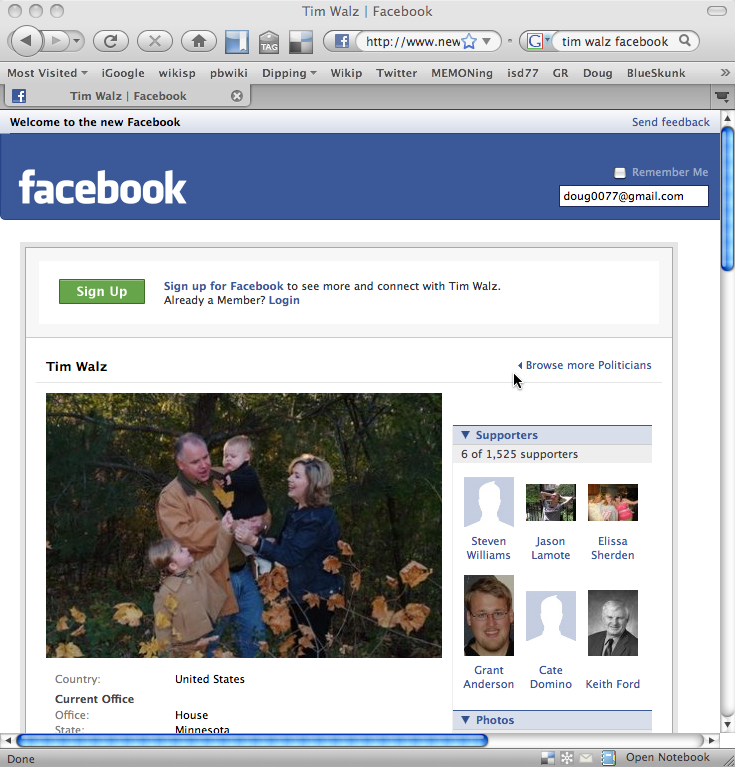
2. That there may be Informational value to having access to Facebook, and that really, we should be blocking based on content, not format. Along with both Obama and McCain, one of our favorite sons, a first year US Representative, uses Facebook to connect with his constituents:

Shouldn't students have access to this information?

3. Facebook is but a single manifestation of social networking, a means of communication and recreation that today's children are growing up with. Club Penguin and Webkinz are popular social networking sites for the pre-school set. Facebook is replacing e-mail as a preferred method of communication. Even educational gaming is becoming more social, as evidenced by new and emerging products like vMathLive.

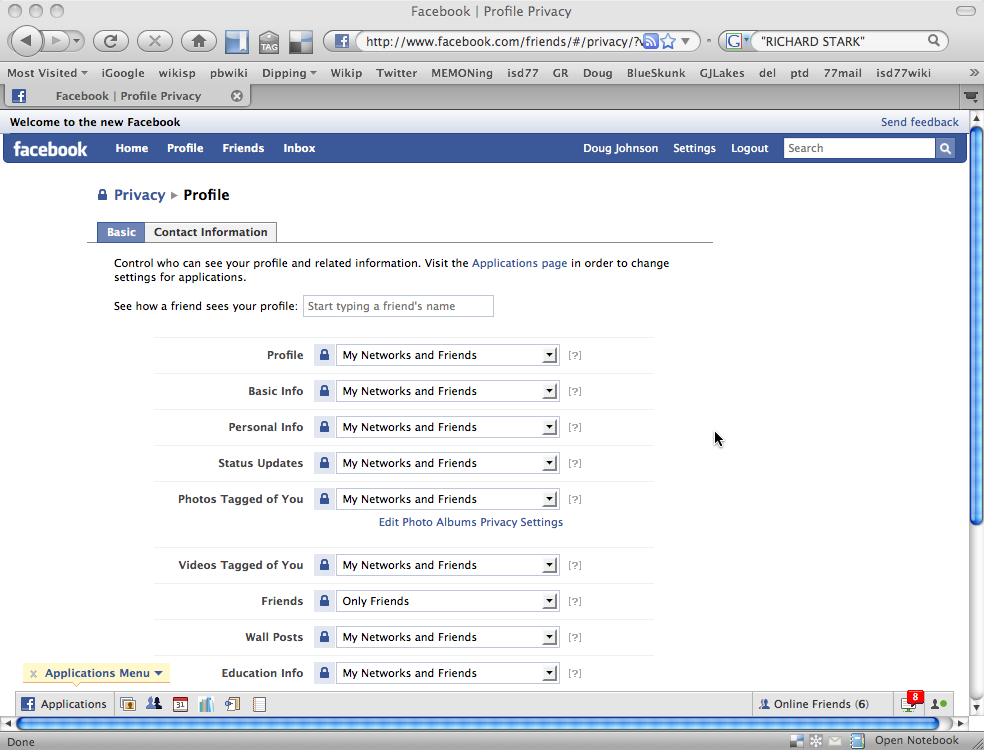
4. Schools DO need to teach safety and privacy with all social networking tools. If we don't, who will? Educators need to know that privacy levels can be set on most sites and children need to know how to do this as well.

5. Safety issues need to be put in perspective by sharing reputable information resources such as Predators & cyberbullies: Reality check by Larry Magid & Anne Collier at ConnectSafely.org. report:

"we do not have a single case related to MySpace where someone has been abducted." - social media researcher danah boyd

Recommend the books MySpace Unraveled and Cyber-Safe Kids, Cyber-Savvy Teens: Helping Young People Learn to USe the Internet Safely and Responsibily. Emphasize that "reputation destruction" and cyberbullying are more likely hazards than predation.

Show:

and 

6. It's OK for individual buildings, libraries and classrooms to set their own rules on what is considered "productive" use of school time and technology. But a district-wide block needs to considered by a range of stakeholders after study, not as a knee-jerk response to any single request.

OK, readers. What would you do at a command performance of administrators asking for a discussion about Facebook? Help me out here...

  I just remembered that I addressed this issue a couple years ago, See also Seven Things All Adults Should Know About MySpace at Education World. Duh.


Friday
08Feb

Is there a place for fear mongering?

Yesterday's keynote speaker at a small tech conference in Marshall, MN, was Mike Detloff, a police officer from Moorhead, MN, working in the Crimes Against Children Unit. His topic was, of course, the dangers children face online.

Now I tend to dislike these sorts of presentations for a number of reasons, and Mike's talk was very similar to many I've heard from law enforcement agents - FBI to the local folks. Heavy on the gory stories of the repulsive acts of pedophiles.  The innocent child snatched from the jaws of an online predator in the nick of time. A strange brew of information about online predators, child pornography, child abuse, public masturbators, missing and abducted children and even serial killers. Of today's popular evils, only Bin Laden usually seems to be missing.

MIke's view of the civil rights of criminal suspects was, shall we say, at odds with the ACLU's. Some of the uses of hidden surveillance cameras he bragged about seemed like entrapment to me. His conclusion that reading books about serial killers showed a propensity to become one did not seem exactly logical. (If we become what we read, I should by now be a gumshoe or a space alien.) And since these things were being addressed at a tech conference, all technology was guilty by association.

11th.jpgI guess I am weary of the use of fear by the government and businesses in this country to sell an ideology or a product. Were one to listen only to law enforcement, the Center for Missing and Exploited Children, or the manufacturers of webblocking/monitoring software, pedophiles lurk behind every web page and every click pushes a child closer to defilement or death. There are too few objective studies and analyses done in this area to help us gain some perspective. I appreciate the Nancy Willards and Ann Colliers and Larry Magids. (The ConnectSafely website has a good list of less sensational articles about Internet safety.)

But Mike made me think as well. More than I really wanted to. I don't want to think about this topic! 

  1. Mike asked: If you are heterosexual, how many years of therapy would it take to make you homosexual? If you are homosexual, how many years of therapy would it take to make you heterosexual? If you are a pedophile, how many years of therapy would it take to make you no longer sexually attracted to children? (Why sex offenders are regarded as such for life.)
  2. Lonely, neglected children are those most at risk from the solicitations of online predators. His line was memorable - "If you don't tell your children you love them, someone else will." YIkes!
  3. He showed the video, The Eleventh Commandment: Honor Thy Children - a wrenching music video on child abuse that is nearly unbearable to watch. (Which also made me feel guilty for ever hollering at my kids.)
  4. I don't know how a person like Mike can work in crimes against children field for years. I have the highest regard for his sense of mission and dedication. I know he does this work for his own children's sake as well.

When I do workshops on Internet safety, I tell participants that while I believe the threat of online predators is over blown, even if there is only ONE such creature, we need to help kids learn to guard against such a threat. It's an unpleasant, uncomfortable topic. But it is one we need to acknowledge and understand. Even when we don't really want to.

Did I mention that Moorhead is the sister city to Fargo - just across the Red River? When Mike is working to protect the area's kids, those kids include my two grandsons. We may not agree on a lot of things, but I am awfully glad Mike is on the job.


Thursday
15Nov

Safe mistakes

email2.jpgThe girl was very upset.

One of our sixth grade girls reported that judging from her sent mail folder on Gaggle.net, someone else had been using her account to send messages. The principal was brought in. The guidance counselor, parents and media specialist all met. And even yours truly, the tech director, got involved.

After some discussion, the girl remembered that she had given her username and password to her "very best friend" at another school, and that they were using the e-mail program at her friend's house on the day the messages (which were innocuous) were sent.

The media specialist changed the girl's password. The counselor gave another talk on cyberbullying. The media specialist emphasized security and privacy in her next lessons. The principal learned the kids actually had e-mail accounts. The tech director was happy this turned into a "teachable moment" for all involved.

It is because of incidents like this that I am glad we have always given our students school sponsored e-mail addresses. It allows kids to make "safe mistakes." The girl and probably her classmates got a real-life lesson in protecting one's password and about identity theft without anyone getting hurt.

It's why we need to give kids as much access to Internet resources as we can while they're in school and while there are responsible adults to whom they can turn if there is a problem. How would this have been handled if the girl had only had a Yahoo account and home access? 

Oh, this sort of thing doesn't happen just to kids either.